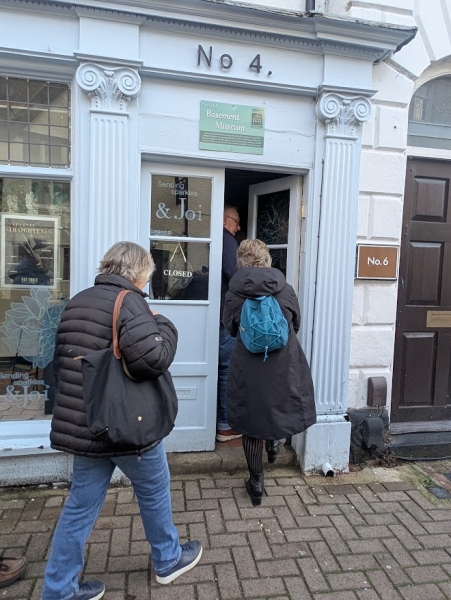
A visit to the large Abingdon County Hall Museum led to an unexpected extra discovery: the Little Basement Museum. Tours can be booked through the museum, and we happened to arrive just as one was starting.
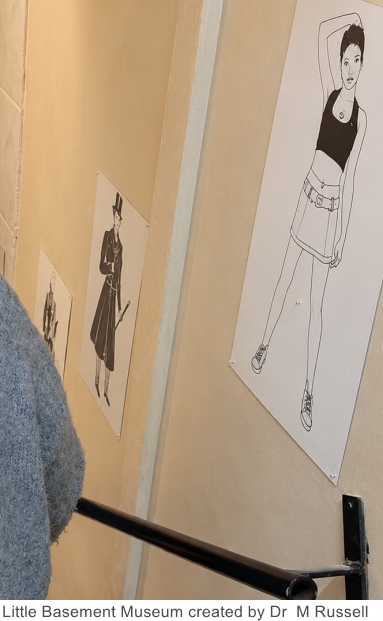
We went down some stairs, passing a display of fashions arranged at 200-year intervals, with the styles becoming progressively older as we descended. The display illustrates how the ground level of ancient Abingdon lies beneath today’s streets. Over centuries, dust, soil and other deposits gradually accumulate, raising the ground level and burying earlier surfaces.
The illustrations were added by Dr Russell, a physicist who took over the building in the 1970s. His curiosity about some stones in the floor led him to investigate what lay beneath. This led to a series of discoveries and eventually the creation of a museum exploring the passage of time at this site.
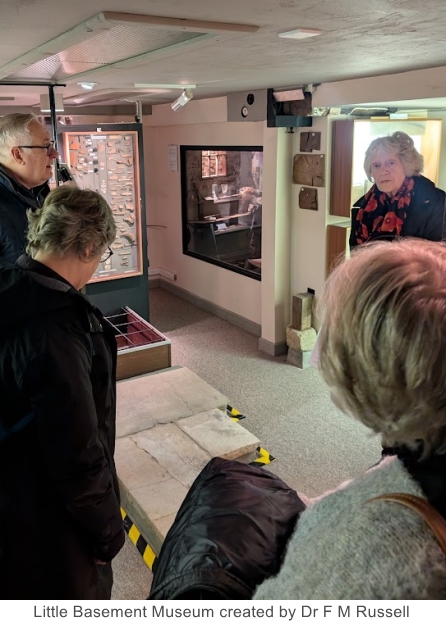
The basement museum contains objects excavated beneath the building: numerous clay pipes, a large intact jar, thought to have been used for storing olive oil and later tobacco, and stone slabs which may have come from Abingdon Abbey.
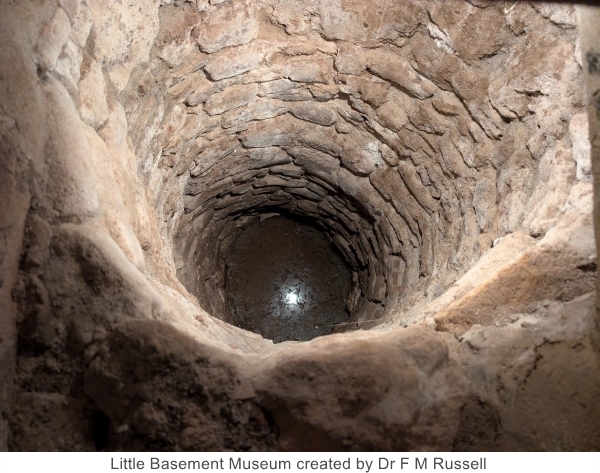
There’s also a well, which has water in it again after running dry during the summer, and an archaeological excavation pit that remains open for further investigation. Research displayed on the walls suggests that people have occupied this site for around 5,000 years. Some of the professions of more recent inhabitants are displayed, including a diorama of a worker with an early metal lathe.
It is interesting to think how many generations have lived and worked here, and the traces that have gradually disappeared under the ground.
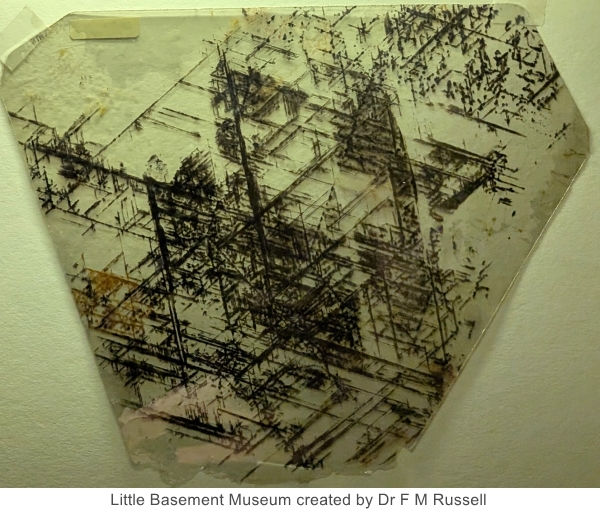
Dr Russell’s investigations have not been confined to what lies beneath the building. Upstairs, he has also pursued scientific discoveries. He investigated unexplained lines found in natural mica crystals. His experiments led to the discovery of a way of transporting electricity through solid materials without applying a voltage. The phenomenon has since attracted further research and may have potential medical applications.
This small building is therefore a place of discovery: an archaeological time capsule beneath our feet. And future looking Science above. As our guide said, “Dr Russell thinks outside the box.”