Category Archives: heritage

Abingdon 100 Years Ago – November 1926


ARMISTICE DAY AT ABINGDON

Yesterday marked the eighth anniversary of Armistice Day, when two minutes’ silence were observed throughout the country in memory of those who died in the Great War.

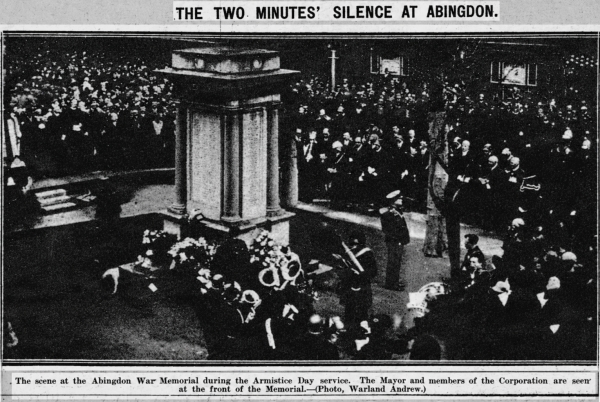
In Abingdon, a large crowd gathered at the War Memorial to honour the town’s 227 fallen servicemen. Among those present were relatives of the men who had died, including families and children who had lost fathers, sons and brothers.

A procession, led by the Salvation Army Band, included the Mayor and Corporation, representatives of the 4th Battalion Royal Berkshire Regiment, local organisations and schoolchildren. Members of the Regiment and the Abingdon School Officers’ Training Corps formed a guard of honour around the Memorial.

The service opened with the hymn ‘O God, our help in ages past’, followed by an address from the Vicar and prayers from local clergy. Lance-Corporal Webb, of the Wantage Platoon of the 4th Royal Berkshire Regiment, sounded the Last Post before the Two Minutes’ Silence, which ended with the Reveille. Children from Abingdon Elementary Schools sang Kipling’s Recessional, and the service concluded with the National Anthem and Benediction.

The Mayor laid a wreath on behalf of the Corporation, while local schools, youth organisations and other community groups also placed wreaths at the Memorial.

POPPY DAY

Flanders poppies were much in evidence throughout the celebrations. From early morning, teams of local women sold the little red flowers in the streets, and almost everyone attending the Memorial service wore one as a symbol of remembrance.

The collection supported Earl Haig’s appeal on behalf of ex-servicemen and the British Legion. Poppy Day headquarters were established at the Square House, with stalls outside the railway station, in the Square and in the Market Place.

ABINGDON BAND

The Town Band will play in the High Street on Saturday evening, commencing at about 8.30, weather permitting.

Owing to the majority of its members being employed playing outside the town, the Band much regrets that it cannot give its usual Remembrance Day service at the Cenotaph next Thursday morning. As in the past two years, however, it will parade on the Square at 7.30 that evening and pay its tribute by playing ‘The Supreme Sacrifice’ and other pieces.

THE MAYOR RE-ELECTED

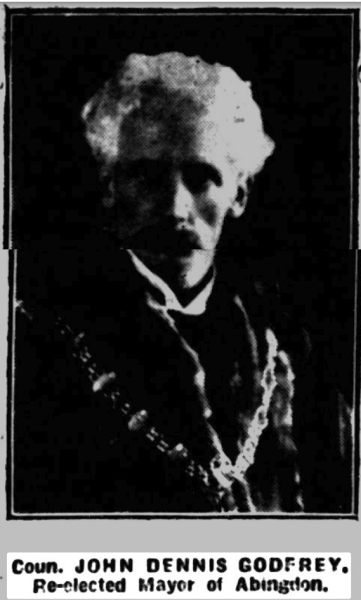
Councillor John Dennis Godfrey has been elected Mayor of Abingdon for the third year in succession.

At the conclusion of the Borough Council meeting on Friday evening, Councillor Godfrey asked members to remain behind for a few moments, when it was decided that he should be invited to continue in office for another year.

SALVATION ARMY ACTIVITIES

Members of the Abingdon Corps of the Salvation Army visited the Workhouse Institution on Tuesday, where they gave a musical service which was much appreciated by the inmates.

A new feature of the Army’s work is the “Children’s Den”, held at the Citadel every Monday evening. Last Monday’s meeting was attended by 131 children.

THE ABINGDON BRIDGE CONTROVERSY

A long-running dispute over responsibility for Abingdon Bridge appeared to be nearing settlement following a report to the Council’s Special Section.

Legal proceedings had been commenced in November 1915 in the name of the Attorney-General, on behalf of the Berkshire and Oxfordshire County Councils and the Governors of Christ’s Hospital, Abingdon.

Following renewed negotiations, the Special Section recommended accepting £2,400 from the Governors, together with any land and other facilities required for proposed bridge works, in full settlement of all outstanding claims. Each party would meet its own legal costs, and the proceedings would then be suspended.

Opinions among councillors differed. One considered the offer generous, particularly as the money would come from a charity with a history stretching back hundreds of years. Mr Young, however, referred to historical records showing that the Charity had previously acknowledged some responsibility for the upkeep of Abingdon Bridge.

HUMANE SLAUGHTER OF ANIMALS

At a meeting of the Abingdon Literary and Debating Society, Mr Norman Graham, Secretary of the H.S.A.S., delivered a lecture on the humane slaughter of animals. Local butchers were among those present.

Mr Graham explained that, although concern for animal welfare was increasing, humane methods of slaughter, including mechanical stunning, were still not widely adopted.

He described traditional methods, including pole-axing and the use of a knife, arguing that these could cause unnecessary suffering if not properly carried out.

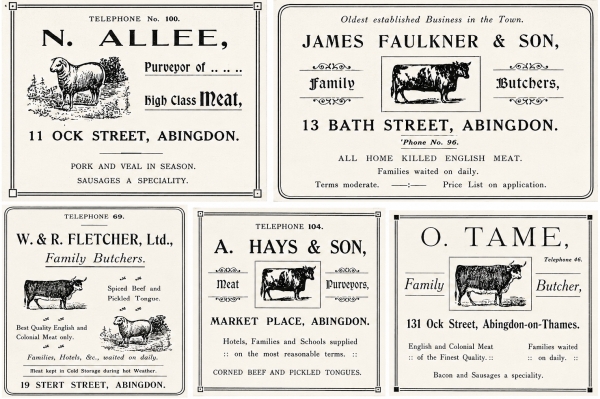
During the discussion, Mr J. Faulkner stated that he had personally killed 50 head of cattle with 50 blows of the pole-axe. Many experienced butchers, he maintained, could do the same, adding that butchers themselves wished to avoid cruelty and to kill their animals humanely.

AN ANCIENT COIN

A Roman coin has recently been unearthed on one of the allotments near the Marcham Road.

The British Museum authorities, to whom it was referred, have identified it as probably a coin of Alexandria in Egypt.

The coin is not considered valuable, but its discovery in Abingdon is naturally of considerable interest.
THE ABINGDON ALMANAC

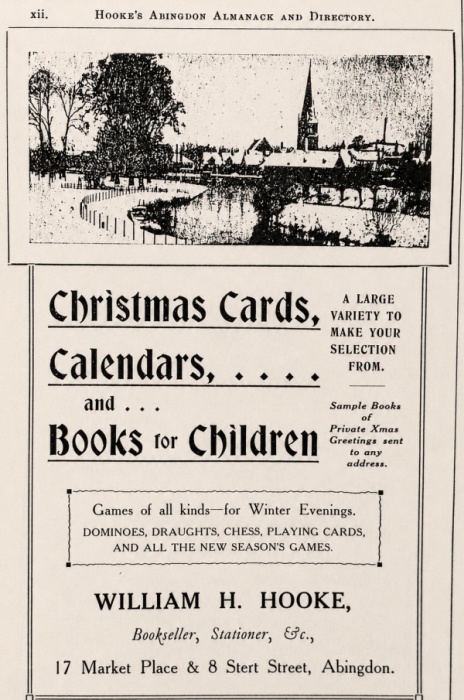
After a lapse of some ten years or more, Messrs W. H. Hooke and Sons have published their Abingdon Almanac and Directory for 1927.

For the modest sum of 3d., the new edition supplies a long-felt want. It contains a complete street directory, useful information about local societies and organisations and their officers, together with particulars of the surrounding villages.

FORMER ABINGDON RESIDENT SENTENCED

A former Abingdon resident, Mrs Lesly Gardiner, has been sentenced to six months’ imprisonment at the Old Bailey for thefts from safe deposits.

She formerly lived at The Warren, Abingdon, where several Oxford and Abingdon tradesmen experienced difficulty in obtaining payment for goods supplied to her. The debts eventually had to be pursued through the Bankruptcy Court.

Acknowledgements

Thanks are due to the to the North Berks Herald microfilm at Abingdon Library for some stories and the British Newspaper Archive for access to the Faringdon Advertiser and Vale of the White Horse Gazette for other stories; and to the Oxford Journal at Oxford Library for the photographs of the Armistice Day event and the Mayor; and the Abingdon Almanac 1927 for the adverts for 5 Abingdon butchers and the Almanac itself.
Discovering Abingdon’s Little Basement Museum


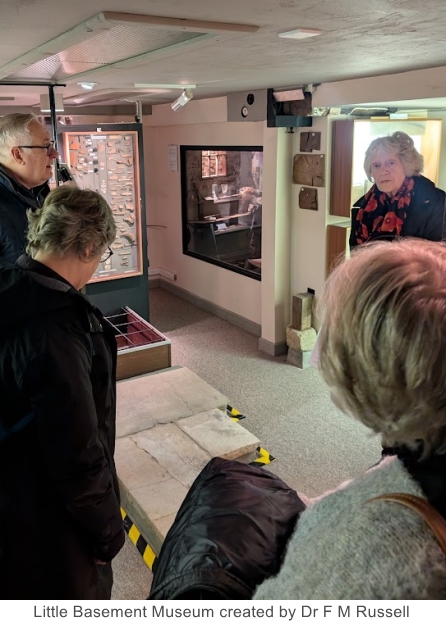
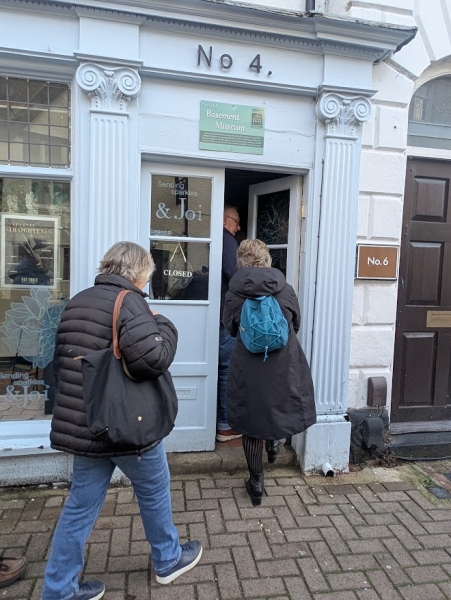
A visit to the large Abingdon County Hall Museum led to an unexpected extra discovery: the Little Basement Museum. Tours can be booked through the museum, and we happened to arrive just as one was starting.

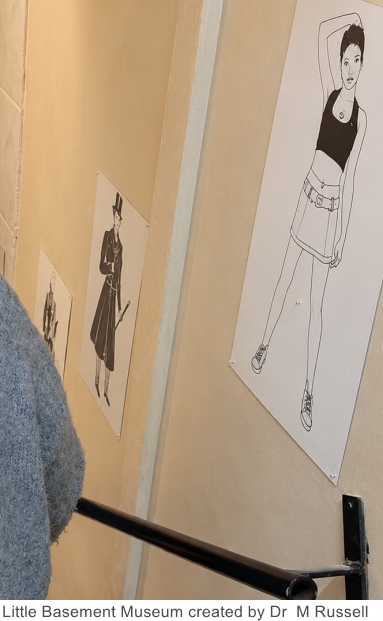
We went down some stairs, passing a display of fashions arranged at 200-year intervals, with the styles becoming progressively older as we descended. The display illustrates how the ground level of ancient Abingdon lies beneath today’s streets. Over centuries, dust, soil and other deposits gradually accumulate, raising the ground level and burying earlier surfaces.

The illustrations were added by Dr Russell, a physicist who took over the building in the 1970s. His curiosity about some stones in the floor led him to investigate what lay beneath. This led to a series of discoveries and eventually the creation of a museum exploring the passage of time at this site.

The basement museum contains objects excavated beneath the building: numerous clay pipes, a large intact jar, thought to have been used for storing olive oil and later tobacco, and stone slabs which may have come from Abingdon Abbey.

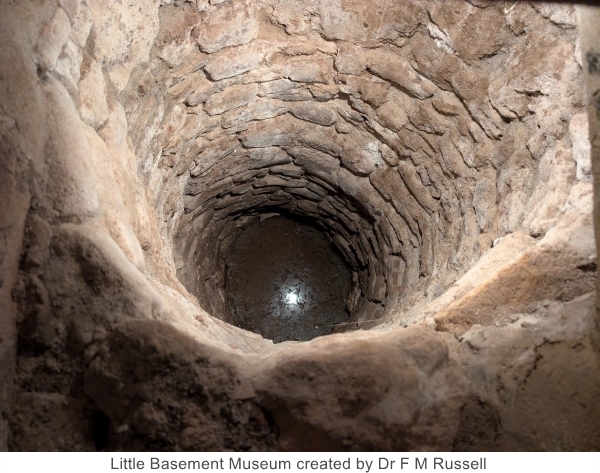
There’s also a well, which has water in it again after running dry during the summer, and an archaeological excavation pit that remains open for further investigation. Research displayed on the walls suggests that people have occupied this site for around 5,000 years. Some of the professions of more recent inhabitants are displayed, including a diorama of a worker with an early metal lathe.

It is interesting to think how many generations have lived and worked here, and the traces that have gradually disappeared under the ground.

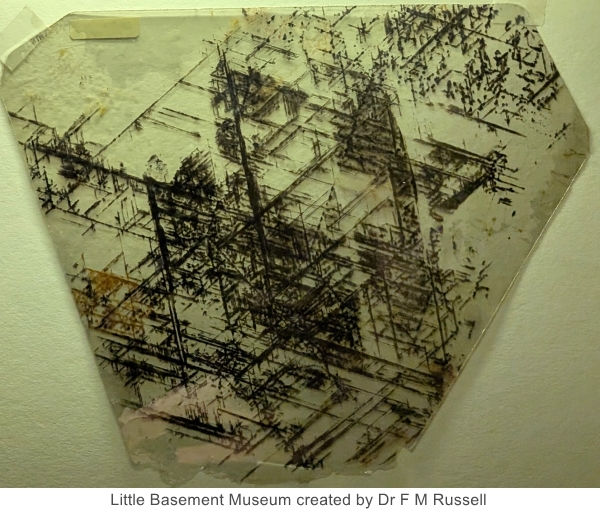
Dr Russell’s investigations have not been confined to what lies beneath the building. Upstairs, he has also pursued scientific discoveries. He investigated unexplained lines found in natural mica crystals. His experiments led to the discovery of a way of transporting electricity through solid materials without applying a voltage. The phenomenon has since attracted further research and may have potential medical applications.

This building is an archaeological time capsule underground with future looking Science discoveries above. As our guide said, “Dr Russell thinks outside the box.”

Abingdon 100 Years Ago – October 1926


Rick Fire

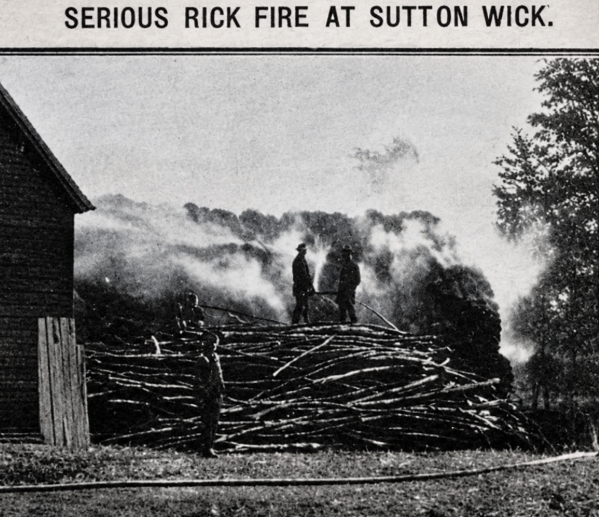
The Abingdon Fire Brigade received a call at 1.45 on Friday morning to a fire at Sutton Wick, and got away in nine minutes. The fire was found to be a 60 ton rick fire, the property of Mr. Henry Aldwinckle, which was well alight. As the fire was in the midst of farm buildings and two straw ricks, the brigade, under Chief Officer J. Gibbons, was working for 64 1/2 hours, returning home at 6.30 p.m. on Sunday. The rick, which is insured, was lighted from the outside.

Coal Rationing
A direction by the Committee appointed by Abingdon Borough Council, and signed by the Town Clerk W. C. Croasdell said that residents were generally limited to obtaining 1 cwt of coal (112 lb, or approximately 50.8 kg) every two weeks, and suppliers could not deliver more if the household already had a stock exceeding 5 cwt (560 lb, or approximately 254 kg), unless the council gave written permission. This was a form of coal rationing, intended to regulate the supply and stockpiling of coal for domestic use.

It went on to say ‘If any person contravenes any of the provisions of the said Directions he shall be liable on summary conviction to imprisonment with or without hard labour for a term not exceeding three months or to a fine not exceeding one hundred pounds or to both such imprisonment and fine, and shall be liable to forfeit to the Crown any goods or money in respect of which the offence was committed.’

Seven Days’ Hard Labour

George Berry (27), described as a platelayer, travelling from Oxford to Newbury, was brought up in custody charged with absconding from the Abingdon Union whilst a casual inmate on October 8. Defendant pleaded guilty.

Mr. James Henry Smith, the Master of the Institution, stated that defendant was admitted to the casual ward the previous night, and on admission was told that he would have to do a day’s work, and would be discharged on Saturday morning. That morning, whilst a man went to fetch his breakfast, defendant got over the door and absconded without doing his wood chopping.

Defendant said he called at the Catholic priest’s house the previous evening and asked for a pair of boots. He was told to call again at 8 a.m. that morning. He wanted to get to Southampton to work, but the previous day he had to walk in his stockinged feet. It was only the fourth casual ward he had been in since the strike began, and he was sure of work when he got to Southampton as they were building new docks there, and there was enough work for about a thousand men for five years. He did not mind going back to do his day’s work.

The Master said that if a man was a genuine case and came to him with proof that he had work to go to, he had authority to release him without performing his task, but defendant, instead of telling him anything, got over the door and absconded. Two other casuals who performed their task the previous day had been let out that morning, and had informed the police that defendant had absconded.

Defendant was sentenced to seven days’ hard labour.

Local Window-Dressing Success

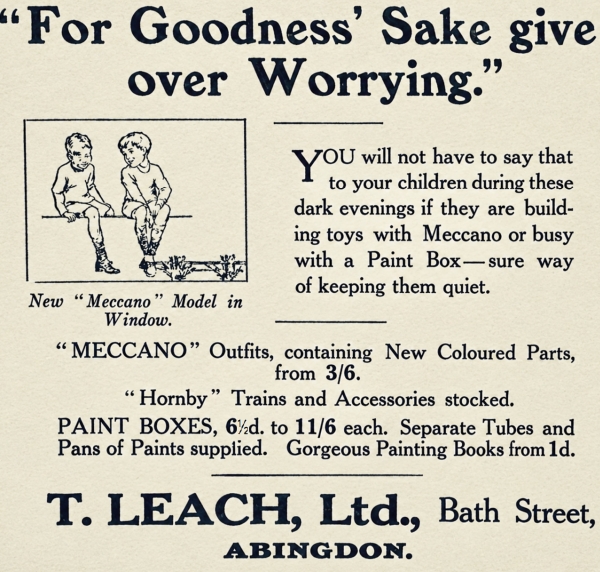
Messrs. T. Leach’s, Ltd., of Bath-street, are to be congratulated on having gained second prize in the national window-dressing competition for a display of books published by Messrs. Hodder and Stoughton, Ltd.

Michaelmas and Runaway Fairs in Abingdon

Abingdon was once again the centre of attraction for large numbers of people from all parts of North Berkshire when the annual Michaelmas Fair visited the town on Monday and Tuesday. For two days, men, women and children entered into “all the fun of the fair”, enjoying a spirit of jollification that offered a brief respite from the troubles brought about by the coal shortage.

The weather was fine for the Michaelmas Fair, which occupied the same area as in previous years and provided much the same amusements. On Monday, around 400 people left on the last train for Oxford.

As usual, the fun was at its height between 6 and 10 p.m. Although the fair did not appear to be as flourishing as in previous years, and even the switchback showed no excessive demand for seats, most visitors seemed to enjoy themselves thoroughly. For many people, and especially for children, the Michaelmas Fair was an eagerly anticipated annual event.

The police were congratulated on maintaining good order throughout the festivities. There were no cases to be heard by the magistrates the following morning.

The Abingdon Runaway Fair was on the following Monday, although the weather was less favourable than it had been for the Michaelmas Fair. The switchback was the principal amusement and attracted a fair number of patrons, while the usual stalls and side-shows were also present.

Abingdon Girl’s Long Walk

Abingdon police and a large band of neighbours and friends in the Vineyard, Abingdon, were engaged in searching the district for Miss Rosie Willis, of 6, Malthouse Cottages, who, leaving home at 9.30 p.m. on Saturday night, did not return. She was found the following day sitting on a seat in North Oxford by a lady, who communicated with the girl’s relatives. Miss Willis was brought home, and after a night’s rest was little worse for her adventure. Mr. J. Willis and family wish to express their thanks to all who in any way assisted them in the search on Saturday night and Sunday morning.

Vicar’s Farewell and Welcome

The Rev. C. S. Fleet preached his last sermons as Vicar of Abingdon on Sunday morning and evening at St. Helen’s to large congregations. At the conclusion of the evening sermon the Vicar thanked the congregation for himself and his wife, for the many kindnesses and words which they had said to them. If he had hurt anyone he must ask their forgiveness and if, on the other hand, he had helped anyone then there was something to thank God for.

The Rev. R. C. MacKeown was inducted to the parish on Saturday afternoon at St. Helen’s by the Bishop, and read himself in on Sunday at St. Helen’s and St. Michael’s.

Sunday Harvest Thanksgiving and the 1926 Crops

On Sunday harvest thanksgiving services were celebrated at the churches of St. Helen, St. Michael, St. Nicolas and St. Margaret. As far as farming conditions are concerned, 1926 will be remembered for its blighted crops and disappointed hopes; it is stated that the corn harvest has failed badly in many of the arable counties. After the favourable and promising weather experienced up to July this failure is doubly depressing. Not only have cereals suffered from blight and the heavy July rains, but beans and potatoes are also affected; potatoes especially have proved most unsatisfactory, and it is to be hoped that no serious shortage will result.

With regard to the year’s fruit crop, plums and damsons have given a good yield, although the plums were very quickly over. One of the most disappointing failures has been in the apple crop – Blenheims especially – and this will doubtless be reflected in high prices at Christmas time. Luckily the pear crop has been more favourable. The majority of the smaller fruits, such as red and black currants, raspberries and gooseberries, were very poor, but loganberries were plentiful.

British Women’s Temperance Association Meeting

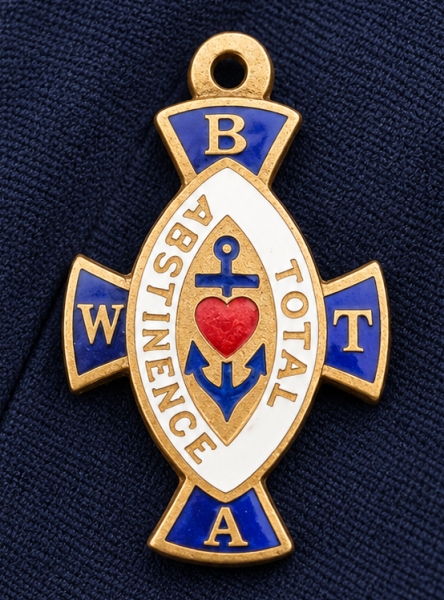
A temperance meeting organised by the Abingdon Branch of the B.W.T.A. was held in the Baptist Hall on Tuesday and was well attended. The singing was especially hearty, and the speaker was Mr. Fulkes, of Oxford, who gave a stirring address on total abstinence. The chair was taken by Miss Morris.

Dog licences

George Silman of Springdale, Lashford Lane, Dry Sandford, was fined 7s. 6d. on each of two summonses for keeping dogs without licences. He explained that he was out of work and had been unable to afford the fees since returning from France. The magistrates gave him 14 days to pay and warned him to obtain the licences.

Jane Doe, a hawker with no fixed abode, was fined 5s. for keeping a dog without a licence. She pleaded guilty and produced a licence she had taken out that day.

Acknowledgements

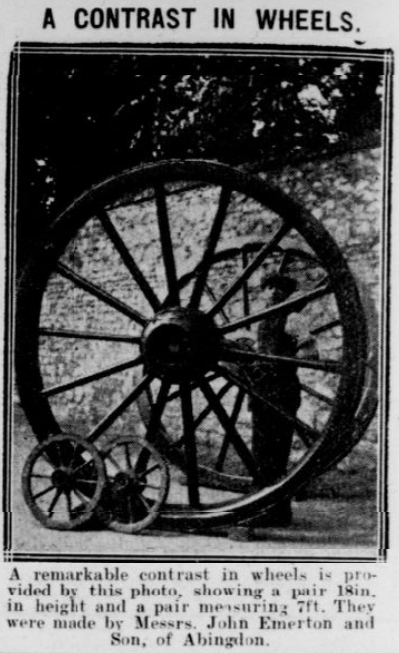
Thanks are due to the British Newspaper Archive for access to the Faringdon Advertiser and Vale of the White Horse Gazette for some stories; to the North Berks Herald microfilm at Abingdon Library for additional stories and the picture of the Leach advert; and to the Oxford Journal at Oxford Library for the photographs of the Wheels and the Rick Fire. The B.W.T.A Badge is from Ebay where it was for sale.

More on the new 1926 Church Hall


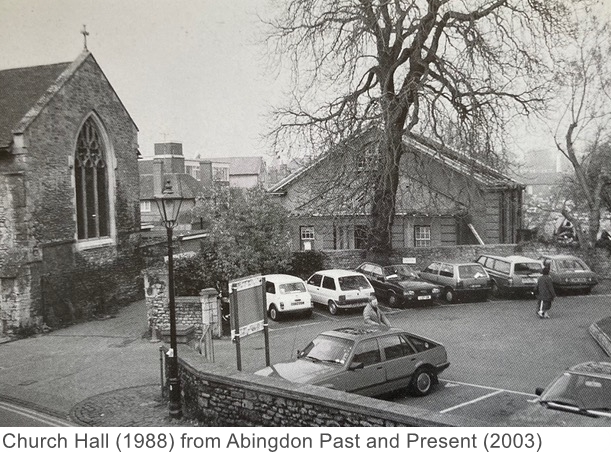
In the feature on Abingdon in September 1926, I reported that the new church hall opened that month, but commenters wondered where it was. Elizabeth sent me a picture that she took – used in Abingdon Past and Present. It answers the question. The picture was taken in 1988, the year before the hall was demolished to make way for the Abbey Close extension from the Vineyard.

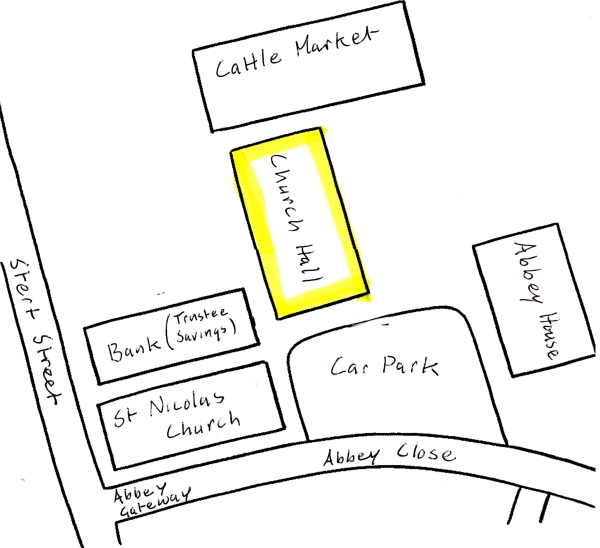
As you can see from this roughly drawn map, the church hall, the cattle market and, beyond that, the railway all stood in the way of the Abbey Close extension.

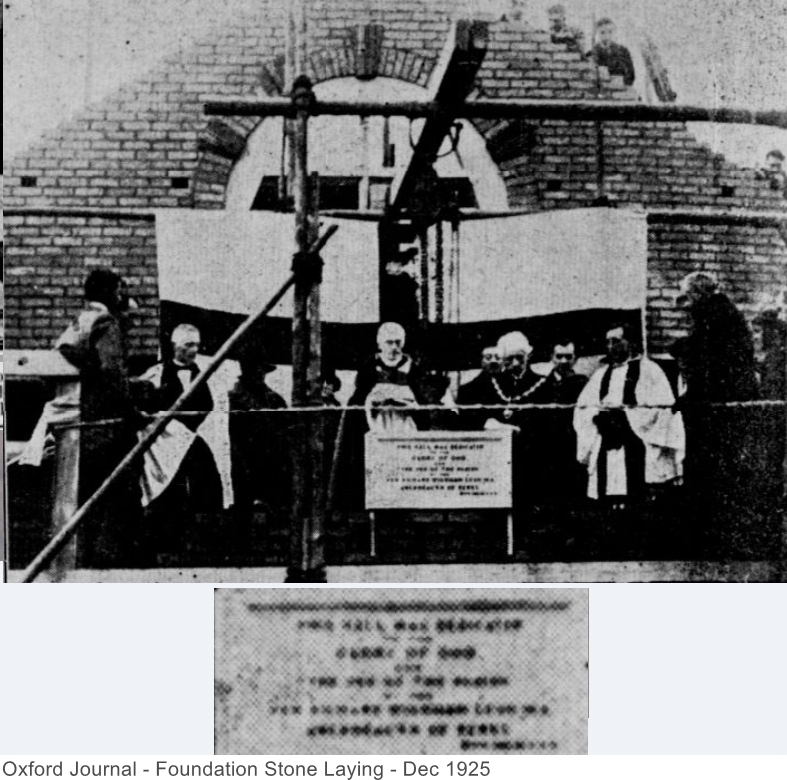
In the Oxford Journal, I found pictures of the hall under construction. This picture from December 1925 is when the foundation stone was blessed by the Archdeacon of Berkshire. The inscription on the stone is not easy to decipher and this is guesswork. It may say, ‘This hall was dedicated … Glory of God …  ????? … Ven Richard Wickham Legg ?? … Archdeacon of Berks.. Anno MCMXXV.’

When I first wrote about the Church Hall back in 2014, Dick Barnes said: “The Church Hall was sited in the Parish of Abingdon St Nicolas, although the legally separate parish of Abingdon St Helen was largely responsible for building and administering it. The dedication tablet over the entrance stated that it was for the benefit of ‘The Parish’.” 

Acknowledgments: Abingdon Past and Present by Elizabeth Drury and Judy Thomas; the Oxford Journal, accessed through Oxford Library.