Category Archives: heritage

The Saxton Family in Abingdon


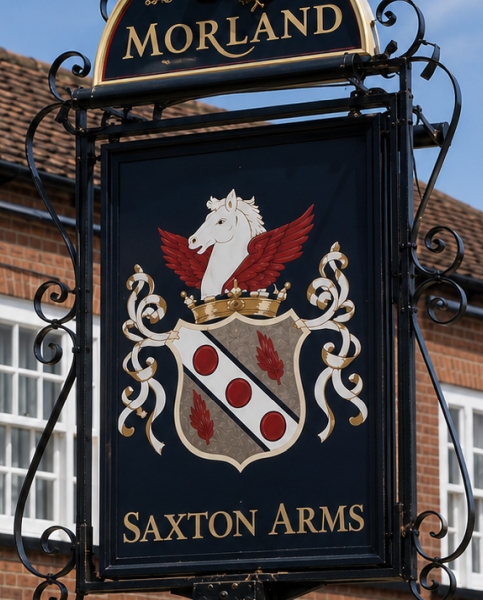
The Saxton Family made a big contribution to Abingdon during the eighteenth and early nineteenth centuries. The Saxton family’s contribution to Abingdon is remembered today through one of Abingdon most famous roads, Saxton Road, where the pub used to display their coat of arms. They also donated two famous royal portraits to the town, and held some distinguished positions in the town.

The family’s association with Abingdon began with Edward Saxton, a merchant and distiller, who was elected Mayor of Abingdon in 1730. (ref 1)
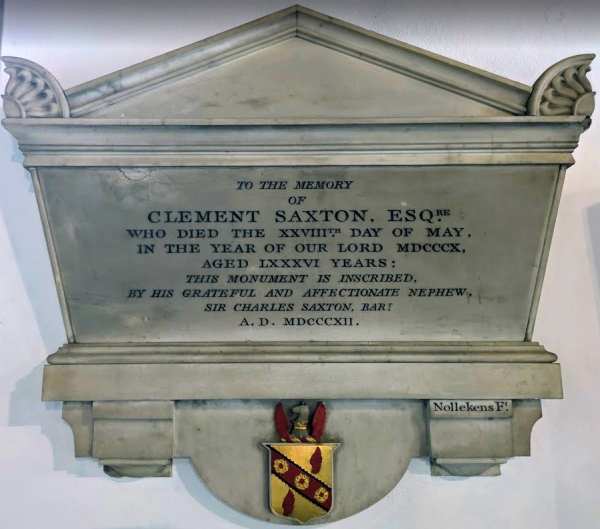
Edward’s eldest son, Clement Saxton (1724–1810), was educated at Abingdon School and enjoyed a distinguished military career in the Berkshire Militia. He served as High Sheriff of Berkshire in 1777, lived at Caldicott (now called Caldecott), supported Abingdon School as a benefactor, and is commemorated with a plaque in St Helen’s Church. (ref 2)
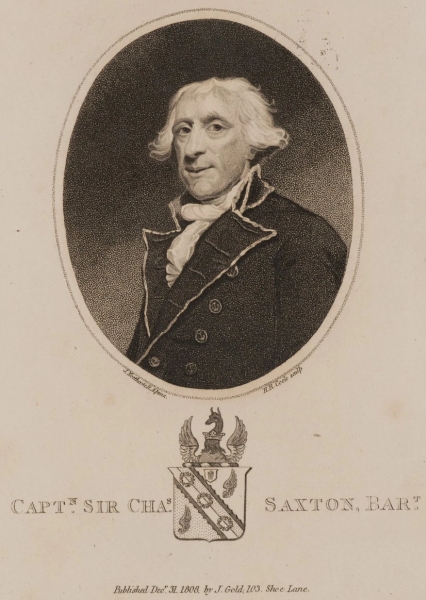
His younger brother, Sir Charles Saxton, 1st Baronet (1732–1808), entered the Royal Navy and after captaining various ships  became Commissioner of His Majesty’s Dockyard at Portsmouth. In recognition of his public service he was created Baronet of Circourt in 1794. (ref 3)
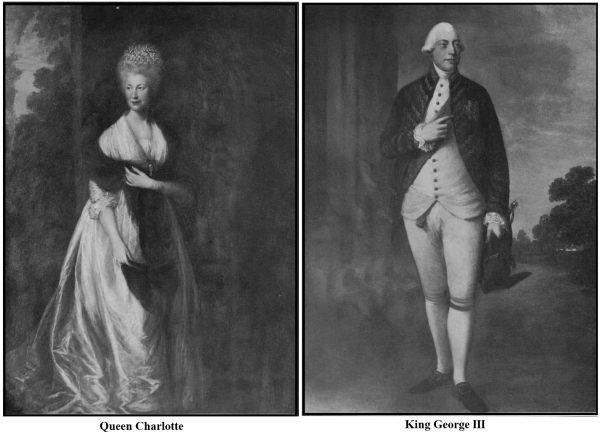
One of his gifts to Abingdon is recorded in the Oxford Journal (18 June 1808): “… full-length original portraits’ of the King and Queen have been presented to the Corporation of Abingdon, by Sir Charles Saxton, Baronet, whose son is Recorder of that town. These valuable pictures have been put up in the Council Chamber…” (ref 4)

The portraits of King George III and Queen Charlotte, partly attributed to Thomas Gainsborough, remain among the town’s most important paintings and are still displayed in the council chamber over 200 years later.
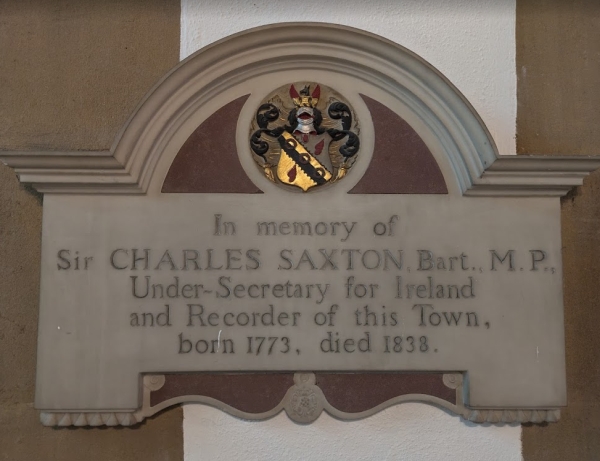
The donor’s son, Sir Charles Saxton, 2nd Baronet (1773–1838), also has a plaque in St Helen’s Church. He qualified as a barrister and became Recorder of Abingdon (the town’s chief legal officer) from 1805 until 1819. He entered government service in Ireland, becoming Civil Under-Secretary to the Lord Lieutenant. In 1812 he was elected to Parliament for Cashel (County Tipperary, Ireland), which he served until 1818. He later served as High Sheriff of Berkshire in 1824–25 and died at Caldecott House in 1838. (ref 3, ref 5)

References

1. Abingdon-on-Thames Town Council. Mayors of Abingdon since 1556.
https://www.abingdon.gov.uk/town-council/your-mayor/mayors-abingdon-thames-1556

2. Hammond, Nigel. Stewards(1743–1822) and Presidents (1893–2009) of the Old Abingdonian Club. Abingdon School Archive uploaded 2020 (original article 2008) p. 8.
https://archives.abingdon.org.uk/wp-content/uploads/2020/03/Hammond-stewards-presidents-part-1.pdf

3. Cokayne, George Edward. The Complete Baronetage, Vol. V. Exeter: W. Pollard & Co., 1900, pp. 287–289 (“Saxton of Circourt”).
https://archive.org/details/completebaroneta05coka/page/288/mode/2up

4. Oxford Journal, Saturday 18 June 1808, p. 3.

5. Jupp, P. J. “SAXTON, Sir Charles, 2nd Bt. (1773–1838), of Circourt, Berks.” The History of Parliament: The House of Commons 1790–1820.
https://www.historyofparliamentonline.org/volume/1790-1820/member/saxton-sir-charles-1773-1838

Abingdon Museum continues the story of the town with an Anglo Saxon exhibition


Following last year’s Roman exhibition, Abingdon Museum is continuing the story of the town and its people with a new exhibition exploring the Anglo-Saxon period from around AD 450 to 1066.

The exhibition shows more of the Museum’s Anglo-Saxon collection, alongside artefacts that are permanently on display.

Among the major discoveries featured are the finds from Barrow Hills and the Saxton Road Saxon cemetery. The Saxton Road cemetery has helped archaeologists learn about the people who lived here over 1,300 years ago. It was discovered after Mr Clargo, a workman digging a sewer trench for the new council houses in Saxton Road, recognised the significance of an urn and a metal object. Because many Anglo-Saxon burials included grave goods, archaeologists have been able to learn about the beliefs and everyday lives of those buried there.

The exhibition is arranged around a series of display boards covering many aspects of Anglo-Saxon life, including the Anglo-Saxon migrations into Britain, jewellery and personal possessions, burial customs, clothing, housing, domestic life and religion. Although Anglo-Saxon houses have long since disappeared, excavations have uncovered post holes and buildings with sunken floors.

The growth of Christianity and the establishment of the Abbey at Abingdon are also explored, alongside the Museum’s rare 7th-century gold ring decorated with glass beads and the famous Abingdon Sword.

The Museum is run by Abingdon Town Council, and it is thanks to its predecessor, Abingdon Borough Council, that most of the Saxton Road cemetery was excavated before the housing estate was built. The exhibition runs until 27th September. Admission is free.

Roger Thomas Launches New Book on Abingdon’s Long History


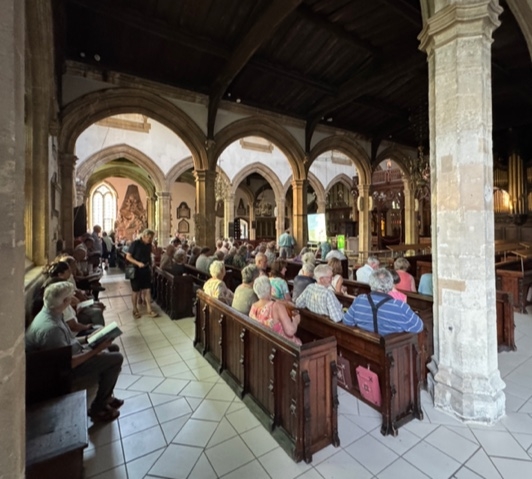
There was a good turnout at St Helen’s Church, Abingdon,

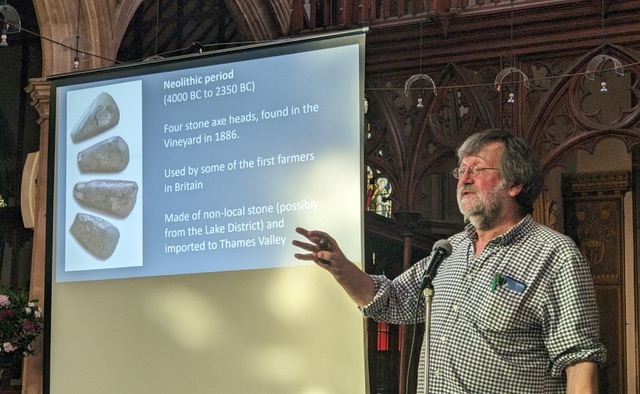
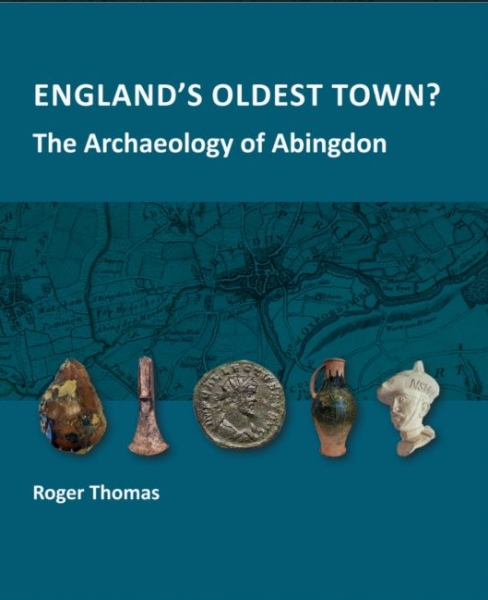
where archaeologist Roger Thomas gave a talk to mark the launch of his new book, England’s Oldest Town? The Archaeology of Abingdon,

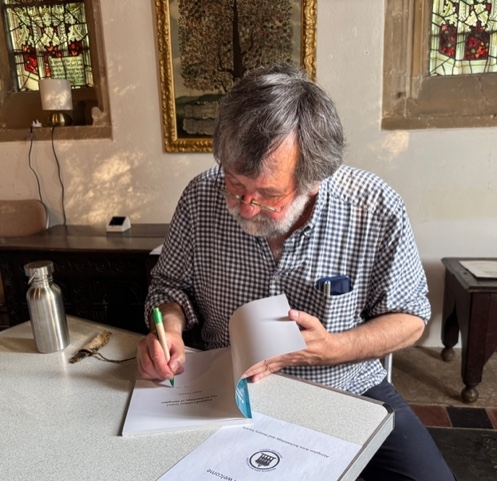
before signing copies for attendees.

The book explores the archaeological discoveries that support Abingdon’s claim to be England’s oldest continuously inhabited town. It is now available from local bookshops and the Abingdon Museum.

Archaeological excavations beneath the town centre uncovered an Iron Age settlement dating back to around 300 BC, including round houses, storage pits and evidence of craft working. Together with evidence of continuous occupation through the Roman, Anglo-Saxon and medieval periods, these discoveries form the basis of Abingdon’s claim to be England’s oldest continuously inhabited town.

(Thankyou to Elizabeth for the pictures)

Abingdon 100 Years Ago – June 1926

Temporary Bridge

After engineers declared the medieval Thames bridge unsafe and closed it to traffic, the main route from Abingdon towards Culham, Dorchester and London was cut. Local businesses complained of lost trade and delayed deliveries as traffic was forced onto lengthy diversions. To restore this connection while the stone bridge was rebuilt, a temporary bridge was constructed alongside the existing crossing.

An Abingdon Bigamist jailed after claiming pension allowance for his “wife”
40-year-old salesman John Lorenzo Marquee Umbandeni Thorburn appeared before the Berkshire Assizes at Reading. Thorburn admitted bigamy and was also convicted of obtaining money from the Ministry of Pensions by falsely claiming he was supporting his wife. In reality, he had married at Windsor in 1915, deserted his first wife after only five weeks, and then went through a second marriage ceremony in Abingdon with Miss Gwendoline Ellison in 1917, with whom he had a child. A veteran of the Royal Field Artillery, he suffered from shell shock and neurasthenia, which drew sympathy in court. When challenged by Ministry officials, he reportedly said: “I think the best thing I can do is commit suicide.” The judge sentenced him to nine months’ imprisonment, remarking that taxpayers should not be expected to support “a man’s mistress”. Thorburn collapsed in the dock after hearing the sentence and had to be carried to the cells by warders.


East St Helen Street couple celebrate their Golden Wedding
Mr and Mrs G. Staniland of 49 East St Helen Street celebrated fifty years of marriage, having been married at St Helen’s Church in June 1876. Mrs Staniland was the daughter of the late Edwin Blagrove of Clarke, Sons and Co. Mr Staniland had spent sixty years working for the Abingdon solicitors C. A. and F. H Pryce and their predecessors. His long list of civic duties included serving as treasurer to the Church Council, election borough auditor, secretary to the Abingdon Provident Institution and secretary of the old Philanthropic Society.

Abingdon Town Band wins prize at Henley contest
Abingdon Town Band travelled to Henley to compete in the third annual Henley-on-Thames Band Contest. The band achieved second place in the march contest in Section Two with its own choice of march, Divisional Command, and finished fifth in the test piece competition.


Long-service medals awarded to Abingdon firefighters
At a meeting of the Abingdon Voluntary Fire Brigade, the Mayor, Mr J. D. Godfrey, presented long-service medals to Chief Officer J. Gibbens, Chief Engineer and Second Officer H. Humfrey and Fireman West. Gibbens had joined the brigade in 1892 and became chief officer in 1923, while Humfrey joined in 1904. Fireman West had served for fifteen years and also acted as brigade secretary. The Mayor praised the brigade’s efficiency and the reputation it had built throughout the district. Members of the Milton Hill Fire Brigade also attended the ceremony.

Territorial soldiers hold musketry camp at Churn
The Abingdon platoon of the Royal Berkshire Regiment joined comrades from Wantage and Wallingford for a weekend musketry camp at Churn. Around sixty officers and men attended under the command of Captain W. D. Gale. Military training was combined with social activities, including an impromptu concert in the canteen on Saturday evening. The men left looking forward to their next camp in early July.

Radley College servant convicted of watch thefts
Reginald Surman, a servitor at Radley College, appeared before magistrates charged with stealing two silver wristwatches belonging to pupils Roger Owen Williams and Ian Standish Wylie. The watches were valued at £3 10s and £1 15s respectively. Surman was fined £1 10s on each charge.

Babies Welfare Party
The annual Babies’ Welfare summer party was held on Friday at the Wesleyan Schoolroom in Conduit Road. The address was given by Miss Kitty Fry, and was followed by the prize-giving and tea.

The prizes were given on attendances made at the weekly weighing-day (Fridays) during the past year. There were over 50 mothers present.

Miss Fry, in her address, emphasised the importance of regular feeding and of never feeding infants between meals. Babies should not be fed at night except when absolutely necessary, but drinks of water could usefully be given when the child cries. Water was necessary for children of all ages, and should be boiled to make sure of its purity. ‘Dummies’ should never be used.

The Health Visitor, Miss Nurse, was presented with a breakfast service by Mrs Beasley on behalf of the mothers and helpers of the Infant Welfare. Miss Nurse is shortly leaving Abingdon to get married.

At the Borough Police Court, Christina Emily Trigg of 4 Thames Street, Abingdon was summoned by Caleb Welch for assaulting him. The complainant stated that he had to push Mrs Trigg’s door shut as he passed on 30 May at 8.30 a.m.. He heard defendant using threats, and when he came back she rushed out, scratched his face, and used obscene language. Mrs. Trigg said the door slammed shut and knocked some ashes she was carrying on to the floor. Witness asked Welch what right he had to bang the door, and he then spat in her face and banged her on the arm. Defendant was fined 10s., including costs, and bound over in the sum of £5 to keep the peace for six months.

Acknowledgements
Thanks are due to the British Newspaper Archive for access to the Faringdon Advertiser and Vale of the White Horse Gazette; to the North Berks Herald microfilm at Abingdon Library for additional stories; and to the Oxford Journal at Oxford Library for the photographs of the bridge, golden wedding and fire brigade.