Category Archives: heritage

Abingdon 100 Years Ago – May 1925


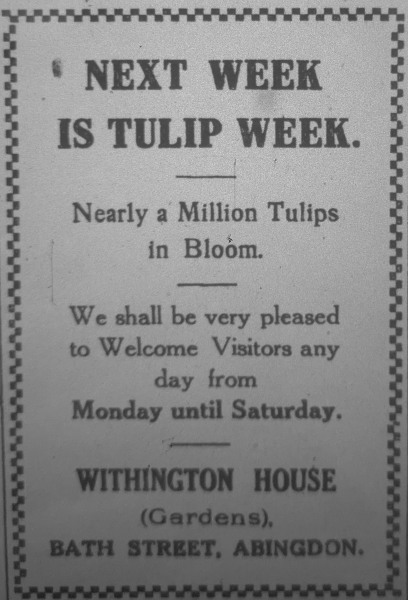
Public Tulip Viewing at Withington House
A public invitation by Mr. H. G. Longford, of Withington House, Bath-street to see nearly a million tulips has been accepted with alacrity. On Monday afternoon, some fifty availed themselves of the opportunity; this number being increased to over five hundred on Tuesday, and over a thousand on Wednesday, whilst on Thursday, the police had to be called in to control the constant stream of visitors. People should remember that to-morrow is the last opportunity to visit the blooms and is open until 7 pm.

Postman’s Thefts
George Laurence Smith, of Park Road, Abingdon, a postman, was charged with stealing £2 10s. in currency notes on April 24th, and a currency note for 10s. on April 25th, the property of His Majesty’s Postmaster General. The defendant was sentenced to three months’ hard labour on each charge, the sentences to run concurrently.

Charles Franklin’s Church Model
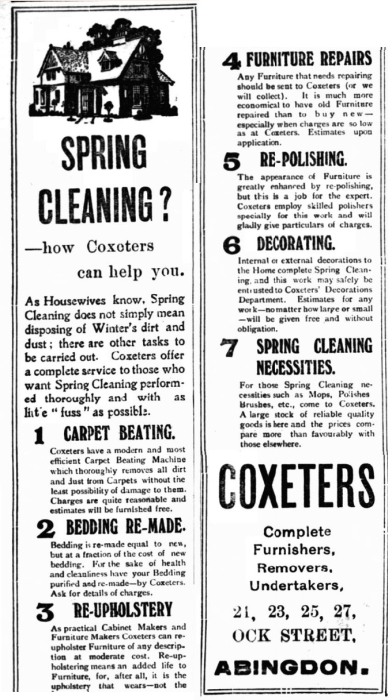
Mr. Charles Franklin, an old Abingdonian now residing in the Long Alley Almshouses, Abingdon,  built an exact model of the early Norman Church of St. Nicolas, which faces the Market-place in Abingdon. Mr Franklin, who is now over seventy years of age, was a bricklayer by trade, and built the model by hand between the years 1885-87. Mr. Franklin has had tempting offers of purchase from London architects and an American architect, but Mr. Franklin intends that it shall become the property of his native town after his death.
Skiff Regatta to continue
The Mayor of Abingdon (Councillor Godfrey) called a public meeting in the Roysse Room on Monday evening to decide whether there was sufficient interest to justify the continuance of the Abingdon Skiff Regatta . The balance sheet showed a balance in hand of £3 7s. 9d. and a loss on last year’s regatta of £8 6s. 6d. After a lengthy discussion it was decided to hold the regatta this year, and that a society be formed to be called the Abingdon Skiff Regatta Association, the members to pay an annual subscription of 1s.

Band Sunday Church Parade
The Town Band held a church parade on Sunday, marching from the band room to the War Memorial, where they played the hymn The Supreme Sacrifice. They then proceeded to St. Helen’s Church, where they played a voluntary before the service, and also accompanied the hymns. The Vicar said the instruments sound all the sweeter through being used in God’s name.

Window-Dressing Competition
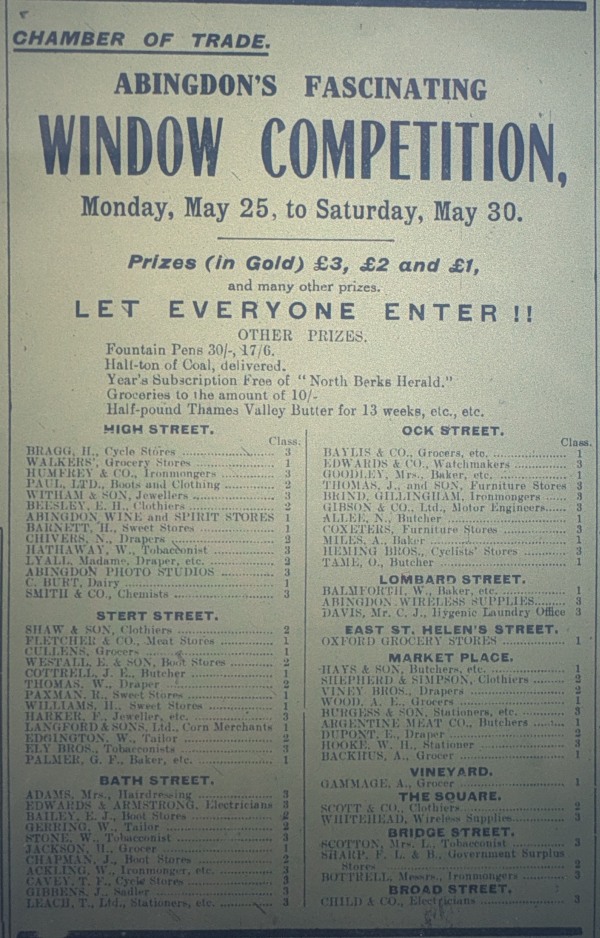
The town has been vigorously canvassed and practically every tradesman has entered the forthcoming window-dressing competition. The windows will be judged by two gentlemen from the magazine ‘Display’, a magazine devoted entirely to window dressing. The window-dressing will be divided into three classes: Food, clothing and general utilities. Each has first and second place. Voting papers will be issued to the public, and handsome prizes will be given to those who pick the winners in the same order as the judges.

Excursions to Wembley & Portsmouth
The Great Western Railway Company announced attractive cheap trips from Abingdon and district for the Whitsun holidays. On Monday there will be a day trip to Portsmouth and Southsea, leaving Abingdon at 6.15 a.m., whilst there will be cheap bookings to the British Empire Exhibition at Wembley.

Lost Library Book Appeal
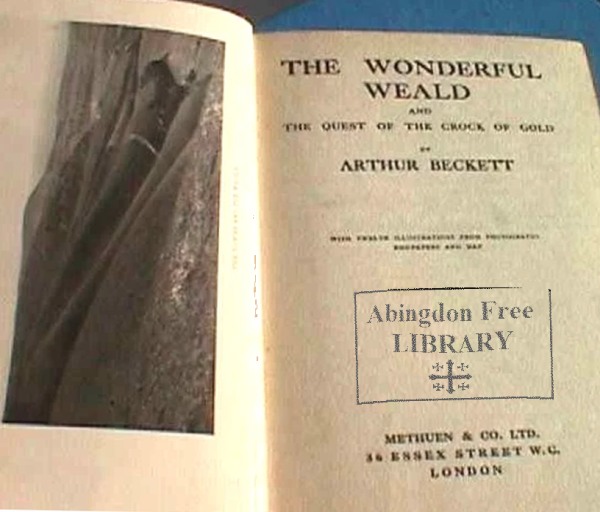
We are asked by the Borough Librarian to appeal to anyone who happens to have a volume called ‘The Wonderful Weald,’ which belongs to the Free Library, to return it immediately.

Girl Guides Empire Day Sermon
The Abingdon Girl Guides attended the morning service at St. Helen’s Church on Sunday, the preacher being the Vicar (Rev. C. S. Fleet), who took as his text St. Matthew, xxiv, 42. In the course of his sermon the Vicar said: Each year strikes me as more extraordinary than we do not make more of the observance of Empire Day. There is something essentially ‘great’ in the thought of Empire Day — and we in England need something great to lift us out of the rut we get into, possibly, due to our living on an island. The Lord Chancellor, speaking at the St. George’s Day dinner, said: ‘I thank God every day that I was born an Englishman,’ but to-day our thoughts go further afield, and those of us who have British blood singing through our veins can think of our brothers and sisters throughout the world and thank God we are members of the great British Empire. It was easy enough during the war years to be loyal and patriotic, but never was there greater need for loyalty, for there are forces at work against the British constitution and against the Christian religion, which can only be counteracted by loyalty to God and the King. We are all very glad to see so strong a contingent of Girl Guides here to-day, and I congratulate those in command. Girl Guides and all kindred organisations represent the true spirit of loyalty, which shows itself not in force of arms, but in service for others, and I would like to remind you girls of those things that really matter — righteousness and loyalty — for in those two words are summed up all you owe to God and to the Empire.

Thanks to the North Berks Herald microfilm in the library and the Oxford Chronicle and Reading Gazette from the British Newspaper Archive. The adverts are also from those newspapers. The missing library book was from Ebay and the Abingdon Free Library stamp was made up.

Abingdon 100 Years Ago – April 1925


Easter Activities

Good Friday (April 10, 1925), was observed quietly in Abingdon, with rain dampening outdoor activities. The traditional hot cross buns were enjoyed, though the street cry of ‘One a penny, two a penny’ was absent, indicating a decline in street vendors. A well-attended three-hour service was held at St. Helen’s Church, led by Rev. J. Mearing. The Free Churches held a united service at the Baptist Church, where Rev. W. J. Chappell, the new minister at the Congregational Church, delivered a sermon on ‘Jesus Christ crucified.’ In Drayton, the Wesleyan Chapel held an anniversary meeting, presided over by the Mayor of Abingdon, Councillor J. D. Godfrey.

Easter Sunday (April 12, 1925), was bright and fair. The Mayor’s official church parade, traditionally held at St. Helen’s Church, took place at Trinity Wesleyan Church. Rev. E. D. Green of Oxford conducted the service (Rev. N. E. Dando, the Mayor’s Chaplain, was absent due to a family bereavement.) The service included a sermon on the Resurrection. Some townspeople were disappointed by the change in venue.

All churches in Abingdon held special Easter services, with 875 communicants across the parish. St. Helen’s Church was decorated by a team of women, with special music, including an anthem performed by the organ and choir, and performances by soloists. The Vicar, The Revd C.S Fleet, preached at the morning service, and Rev. J. K. Sitwell preached at evensong.

On Easter Monday (April 13, 1925), the weather turned dull with rain until the afternoon. Abingdon Kinema’s Holiday Programme drew crowds, featuring The Gay Corinthian and footage of the Boat Race and Grand National. The Abingdon Bowling Club’s season-opening tournament was postponed due to unplayable greens. The usual holiday football matches were spoiled by the weather, but the evening was fine and was enjoyed by many who wished to take the air.

Other Activities
The Abingdon Branch of the Junior Imperial League celebrated its first anniversary with a concert and dance at the Corn Exchange. Major Ralph Glyn, M.P., emphasised the importance of local government and encouraged young members to pursue public service. Awards were given for election work, and the event featured music, dancing, and a humorous sketch.

The Abingdon Madrigal Society and Culham College Men’s Choir performed a sacred concert at the Corn Exchange, featuring Handel’s Messiah, which has not been performed locally for several years. The choruses were well-performed, and the soloists acquitted themselves admirably.

The Abingdon Chamber of Trade planned a window-dressing competition for May 1925, dividing tradesmen into three classes with prizes for the best displays. Additional contests included school essays, limericks, and snapshots of shop windows.

The induction of Rev. W. J. Chappell as pastor of the Congregational Church was a major town event, attended by the Mayor, Mayoress, and community leaders. Speeches emphasised the church’s role in addressing social ills and improving the town’s moral fabric.

The Northcourt Women’s Institute attended a regional meeting with 150 members from nearby villages, discussing agricultural education (bee-keeping, poultry, dairy, gardening). After tea, there were games and two competitions – both won by Northcourt.

The Abingdon platoon of the 4th Battalion, Royal Berkshire Regiment, was selected for the Southern Command Miniature Rifle Shooting Competition. The honour is especially notable given that the platoon consists of young soldiers, many of whom have only a year’s service.

On Monday last, a horse and heavily-laden van was being driven from the Market Place towards Bridge Street when the reins broke, causing the horse to bolt. P.C. Leonard Gould, who was on duty in the Market Place, promptly rushed forward and seized the reins, and was carried twelve yards before bringing the animal to a standstill. His courage probably averted a serious accident and onlookers expressed admiration for his bravery.

The Abingdon Imperials defeated Stanford 4-1 in the 1925 final of the North Berks War Memorial Cup at Alfredian Park, Wantage. Despite difficult conditions, the Imperials controlled much of the play, with Salisbury opening the scoring and Smith adding a second. Stanford pulled one back with a corner from Wheeler, but the Imperials sealed their victory with two more goals.

Thanks to the North Berks Herald microfilm in the library and the Oxford Chronicle and Reading Gazette, available through the British Newspaper Archive. The adverts are from the North Berks Herald and the Croydon Times.

The Old Bridge over the Stert


John sent in this fascinating photo of the old bridge over the River Stert — a hidden route that links Clifton Drive to Boxhill Park through a gap in the hedge. He tells me he used the bridge many times but has no idea of its history. Perhaps someone reading this does?

One particularly curious detail: the large tree you can see in the picture isn’t just next to the bridge — it’s actually growing out of it. John describes it as quite extraordinary. And I agree.

There’s been some tree work nearby recently, with a number of trees felled along the riverbank, but the bridge itself appears neglected. John wonders why there’s no visible effort to preserve it. It’s not just a practical footpath, but a part of Abingdon’s history being slowly reclaimed by nature.

I know the Town Council manages Boxhill Wood, but I’m not sure who’s responsible for the bridge or this stretch of the Stert. If anyone has more information — perhaps about the bridge’s age, who maintains it, or what its original purpose might have been — John and I would love to hear from you.

A Brief History of Pulpit House and Old Mast House


Following a query about the history of Pulpit House and Old Mast House — now both up for sale — here is a summary based on information from a booklet called ‘Over 300 Years of Living History.’

In 1700, Abingdon’s Congregationalists built their first modest church near the Square. In 1862, the church was enlarged, incorporating 18 feet of the original 1700 building into the new construction. The church grounds were then enclosed by iron railings, as shown in the etching below.

By 1966, the Congregationalists joined with Trinity Church and vacated the old church.

The original church building in the Square faced planning delays — at that time, the A34 ran along High Street and Ock Street, making access and parking difficult. The building was used variously as an arts centre and even for skateboarding before its eventual sale in 1980.

It was later converted into offices for a marketing company, which received a design award from the Vale of White Horse District Council (VWHDC) in 1987. The company moved out some time before 2006. In 2008, Ask Restaurant moved in and continues to operate there today.