Temporary Bridge Opens While Abingdon Bridge is Unsafe
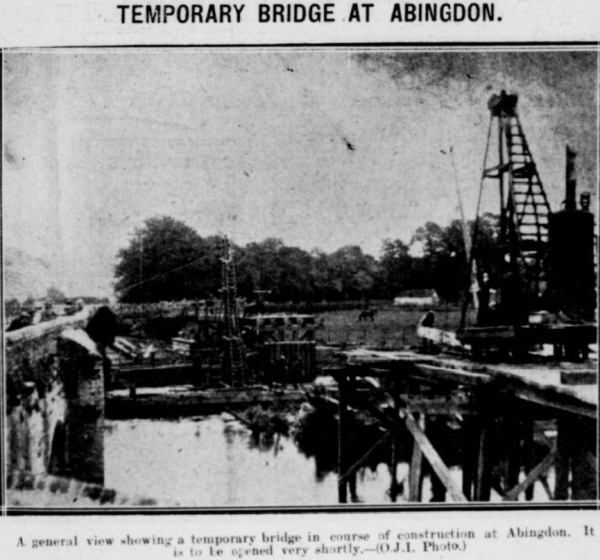
The temporary bridge across the River Thames opened to traffic in early July.
It had been designed to carry what was described as a “30 cwt. lorry” — meaning a lorry capable of carrying a load of 30 cwt., or a total vehicle weight, including the vehicle itself, of five tons.
The bridge operated as a one-way crossing, with a man stationed at each end to signal traffic. Piles had been driven into the river to support the central section, while trestles and cribs supported the structure on the land.
The temporary crossing was an important solution to keep traffic moving while the future of the old bridge was considered.
Abingdon Man Killed in Motorcycle Crash at Sandy Lane Crossroads
A tragic accident occurred at Sandy Lane Crossroads, Tubney, about eight o’clock on a Sunday evening, when an Abingdon man sustained fatal injuries.
John George Cox, aged 21, of 34 Bostock Road, Abingdon, was riding a motor-cycle and sidecar from Appleton towards Abingdon, accompanied by Harry Viner of Winterbourne Road.
At the crossroads, the motorcycle collided with a motor car driven by Mr Reginald Panes and owned by Mr Tracy Percival Rogers of “Friezewood”, Rudgeway, Bristol. The car was travelling from Oxford towards Faringdon. The force of the collision turned the car completely around, and Cox was seriously injured.
Another motorcycle following behind was also involved, with the rider being thrown from his machine.
Cox and the other injured rider were taken to the Radcliffe Infirmary, where John George Cox died the following morning at 6.20am.
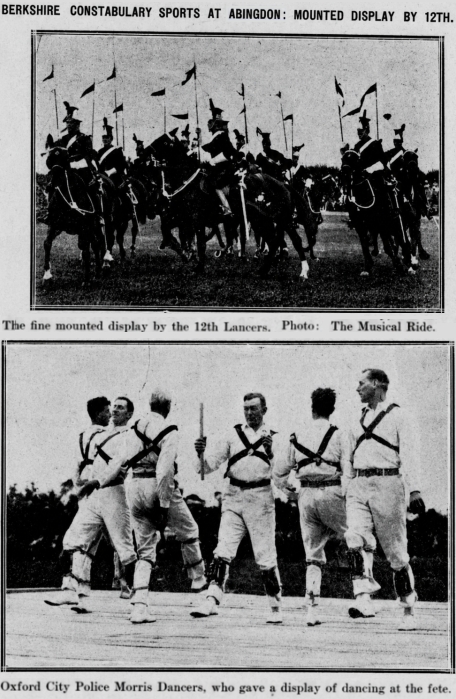
Berkshire Constabulary Sports Bring Large Crowd to Westfields
The nineteenth annual Berkshire Constabulary Sports were held at Westfields, Abingdon, and attracted a record crowd.
The main attraction advertised beforehand was a musical ride and mounted display by the 12th Royal Lancers, accompanied by their regimental band.
The display proved to be the highlight of the afternoon, with spectators impressed by the skill and precision of the Lancers’ horsemanship.
The sporting competitions were also warmly received, particularly the keenly contested tug-of-war between police teams, which proved especially popular with younger spectators.
Superintendent Goddard was praised for his leading role in organising the successful event.
Abingdon Skiff Regatta Held on the Thames
The Abingdon Skiff Regatta was held in July and was regarded as a sporting success, although the attendance was smaller than hoped.
The weather was thought to have played a part in reducing the size of the crowd, while reports also commented that delays between races could discourage spectators.
Despite this, competitors supported the event strongly, with 56 entries received — only ten fewer than the previous year’s record.
The organising committee was already considering ways to improve future regattas, including the introduction of a novelty event during intervals to entertain visitors between races.
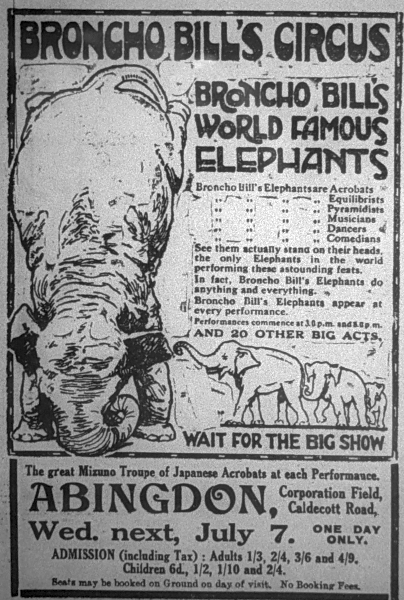
Broncho Bill’s Wild West Circus Brings Elephants to Abingdon
Abingdon welcomed a very different form of entertainment in July 1926 when Broncho Bill’s Wild West Show arrived in town, bringing with it two famous performing elephants: Salt and Saucy.
Ahead of the performances, Broncho Bill explained that the elephants were both 28 years old and had already spent twenty years entertaining audiences in major cities around the world. Their appearance with the circus was their first time performing with a show in Great Britain.
Saucy’s most famous act was balancing on her head, a trick which had reportedly taken three years to master and was claimed to be unique.
The circus also travelled with a baby elephant, giving audiences the chance to see animals rarely encountered in everyday life.
Broncho Bill gave an insight into circus life, including the fact that the elephants’ toenails were filed and polished every three weeks so that they looked their best beneath the bright stage lights.
Roysse’s School Founder’s Day Celebrations
Roysse’s School celebrated Founder’s Day in July with the traditional service at St Helen’s Church.
The service was conducted by the Rev. J. K. Sitwell, with Archdeacon James, C.B.E., preaching the sermon. The Head Master, Mr W. M. Gundy, read the lessons.
Following the service, the annual prize-giving took place in the Corn Exchange, with Major R. G. C. Glyn, M.C., M.P., presenting the prizes.
Tea was afterwards served in the school grounds, while the City of Oxford Military Band played selections for those attending.
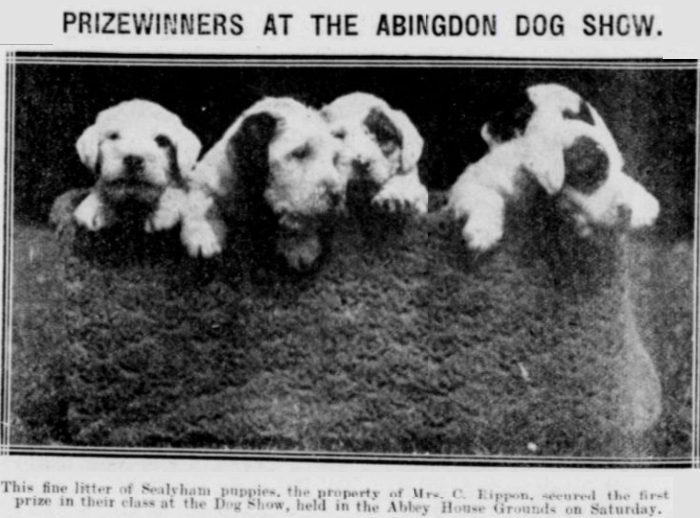
Northcourt Canine Club Dog Show at Abbey House Grounds
Dog lovers gathered at the Abbey House Grounds in July for the second annual open dog show organised by the Northcourt (Abingdon) Canine Club.
The event attracted more entries than the previous year, and the quality of the dogs was reported to have improved, particularly in the Sealyham classes.
The judges included Mrs Leismore Gordon, Miss Tetlet for Cocker Spaniels, Mrs W. R. V. Morgan, H. Yarrow, Vanham Smith and W. J. Nichols.
The attendance was described as good, and the show was considered a considerable success.
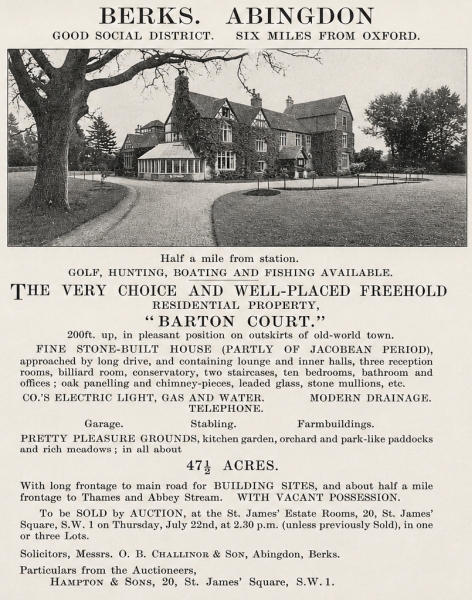
Historic Barton Court Put Up for Sale
A notable historic property in Abingdon came onto the market.
Barton Court, associated with the poet Algernon Swinburne and his biographer Theodore Watts-Dunton, was announced for sale by auction.
The property, owned by Mr C. L. Gray, was partly Jacobean and partly Georgian, with later additions. The buildings dated from 1665, 1748 and 1860.
The grounds contained the remains of Old Barton Abbey, described as the ruins of an ancient Benedictine Abbey dating back to the ninth or tenth century.
Mr Gray explained that “the Abbey” had been the old guest-house of the Benedictine monks.
Waifs and Strays Society Fête Held in the Abbey Grounds
A charity fête was held in the Abbey Grounds in aid of the Waifs and Strays Society.
The event was opened by the Hon. Mrs Glyn and included a variety of stalls and entertainments.
Children from Dry Sandford School, under the supervision of Mrs Roberts, performed maypole dancing, which was greatly appreciated by those attending.
Mr Ackling’s Band provided music throughout the afternoon and later played for dancing on the lawn.
Borough Council Ends Farming Operation
At a meeting of Abingdon Borough Council , a decision was taken to end the council’s farming operation.
A motion was passed to terminate the farming activities, sell the stock and crops, and let any land not required for sewage disposal purposes.
The decision marked a change in the way the council managed its land and municipal responsibilities.
Acknowledgements
Thanks are due to the British Newspaper Archive for access to the Faringdon Advertiser and Vale of the White Horse Gazette for some stories and Country Life for the Barton Court Advert; to the North Berks Herald microfilm at Abingdon Library for additional stories and the advert for the circus; and to the Oxford Journal at Oxford Library for the photographs of the bridge, dogs and Berkshire Constabulary Sports.