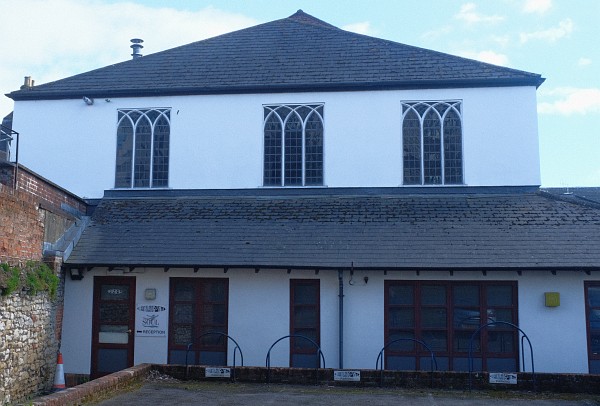
The best pictures I can take walking round the new development by the Dunmore Road is to show heaps of earth and piles of pipes. This picture is taken from Tilsley Park with the houses of Dunmore Road behind.

From the Wootton Road the first houses can be seen going up.

But Daniel with his Bird’s Eye View gets something much better.

This is the view looking from Tilsley Park towards the Wootton Road with the existing houses of Dunmore Road top left.

This is the view of the development entrance and the first houses. Daniel hopes to return fairly frequently to show progress from the air.
Author Archives: Back Streeter
Roysse School Gothic Gateway

The Gothic Gateway that once led to the yard of Roysse School has a coat of arms for John Roysse.

The other two coat of arms have only partly survived. The Borough of Abingdon arms are still recognizable to the right.
A picture by Henry Taunt shows the other coat of arms with the date MDCCCX1 (1811) is for the Earl of Abingdon.
According to Agnes Baker, the 5th Earl of Abingdon gave £100 towards building the gateway. Accounts show the gateway was made by local craftsmen for £99. 10. 11½. The Earl’s arms were added in gratitude. Borough and school also contributed to school improvements in 1811.

The current Earl of Abingdon (the 9th) was born in 1931 and I took this picture during a visit to Abingdon during 2006 (450th Charter Anniversary). Peter Green was the Mayor of Abingdon at the time. The Earl of Abingdon is next to Peter (in the double breasted suit).
(source: Historic Abingdon – 56 Articles by Agnes C. Baker)
Abbey Fish Ponds – March 2021

Today was the first sunny day since the start of Spring. Hawthorn leaves are growing from buds around the Abbey Fish Ponds Nature Reserve in Abingdon.

Blackthorn blossoms appears before the leaves.

At the north edge of the Abbey Fish Ponds a whicker fence provides a barrier to the slope down to the reedbeds. Young trees have been planted with plastic guards and will replace the fence in time.

A north-south path crosses over a brook and forms a cross roads with the main east-west path that follows the brook.

The banks of the brook are green with new vegetation.

Fresh reeds (or sedges) are pointing up from the shallow ponds beside the main path.

That main path goes from the Radley Road to Audlett Drive.

Many birds can be heard. Fewer can be seen. As the nature reserve is close to houses there are domestic cats prowling near the edges and so birds are best to be wary.
Abingdon Independents

The Independent dissenters would make their way in ones or twos to a shady tree lined place beside the River Thames, or a clearing in Tubney Woods. Their leader, Dr Langley, would be the last to join, and announce the opening hymn.
They claimed to gather under a higher law than the Act of Uniformity – that required them to go to the established church. The Independents felt no need of polished stones or painted glass. They said, ‘Light shines best in hearts made right with God.’
The Toleration Act of 1689 gave them license to meet at Dr Langley’s home in Tubney, and then a Meeting House was built and opened beside the Square in Abingdon – about the same time the Baptists and Quakers got their own place. It opened in the year 1700.
Men stood one side of a crowded gallery, women the other, with families in pews below.
An old ship’s mast held the roof. Some would claim the Pilgrim Fathers were powered through storms by that ship’s mast – chancing all on God. More probably, the mast came from a North Sea wreck that once carried a Minister of the church.
After a long week of hard work and a long walk to church, some villagers, in long smock coats, chose to stand – lest drowsiness rob them of a crumb of the truth they lived their lives by. Fisher, a farm-labourer; and aged Mr Doe would claim, ‘so long as legs can carry us, we will be here for the worship’.
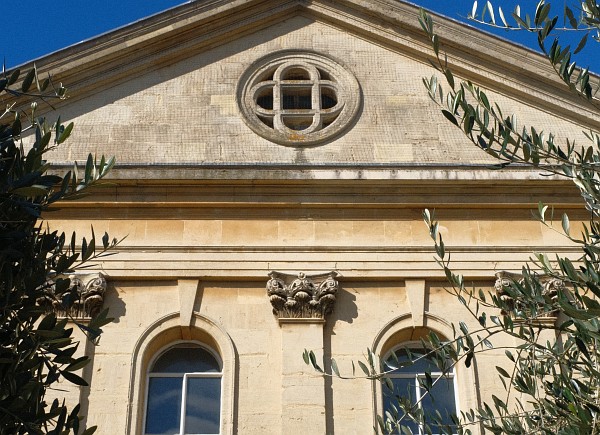
The meeting house was enlarged with a classic front, and the older building became the school room. The celebrated preacher Charles Spurgeon preached to rapt crowds that day, and the ticket price helped clear the building debt. It was a day of unity. The Mayor and Rector declared that all were now working in the same faith.
The Independents became the Congregationalists and then joined with Presbyterians to become the United Reformed Church (URC). The Abingdon URC then joined with Trinity Methodists and left their old building.
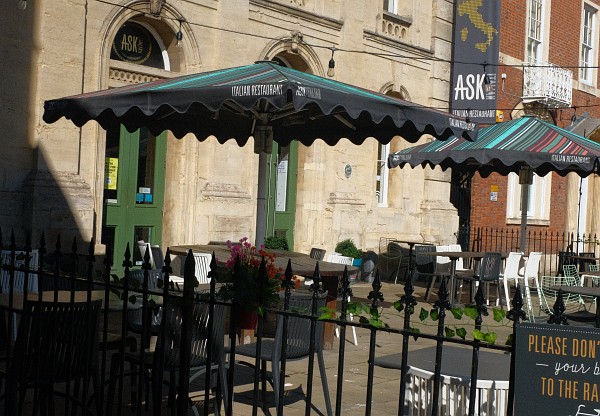
Their old meeting house is now the Ask Restaurant. Some still claim that the ship’s mast could be from the Mayflower.
Summary written after reading Two centuries young : Abingdon Congregational Church 1700-1900 by Dr John Stevens. Phrases in quotes are directly taken from the book.