Category Archives: war

Stone and Wood WWI and WWII roles of honour

Stone and Wood
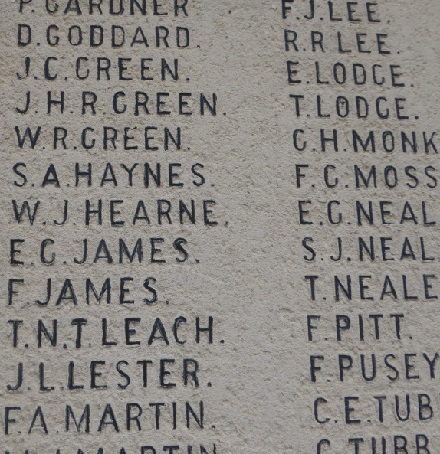
Before the names of the Abingdonians who died in WWI could be carved on the stone war memorial
Stone and Wood
their names had already been carved on wooden memorial tablets now on display near the font in St Helen’s Church. The names on the wooden memorials have the full first names, not just initials.
Stone and Wood
Between the larger WWI tablets is a WWII tablet

Thanks to Mike for pointing this out.

11th November – Armistice Day at the war memorial

11th November - Armistice Day
The First World War, which had begun on 28th July 1914, ended this day, ninety nine years ago, on 11th November 1918.

This war involved the great world powers of the time. Over 9 million combatants died, and many millions more were permanently disabled. Over 7 millions civilians across Europe and other war zones were killed. Many millions more were injured, and made homeless as a result of the war to end all wars.

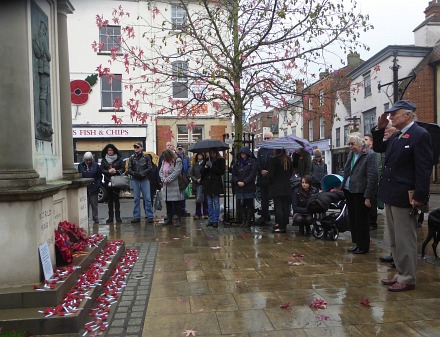
Hostilities ended at the 11th hour of the 11th day of the 11th month of 1918 with the signing of the Armistice. And so at that hour today people gathered round the war memorial in Abingdon for a minute silence.

The formal Remembrance Day ceremony is tomorrow.
11th November - Armistice Day
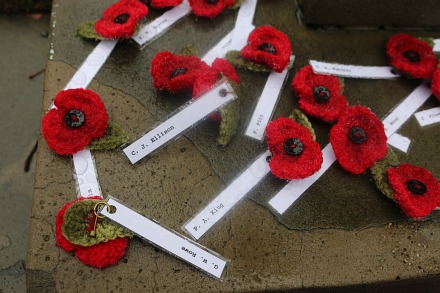
Scattered around the war memorial somebody had laid wool poppies, one for each named person on the war memorial. People were invited to take one.
11th November - Armistice Day
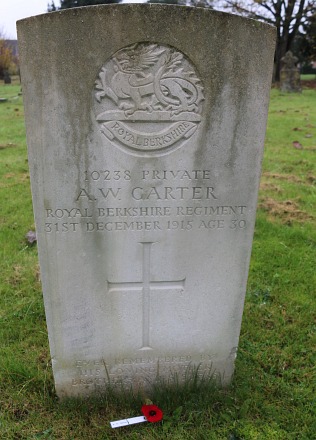
Here is the one for A W Carter next to his gravestone at Abingdon’s Old Cemetery.
11th November - Armistice Day
A report from the Reading Mercury of 8th January 1916 tells of his funeral.

King Street – Private Percival Arthur King

Thanks to a relative for this piece
King Street
To commemorate the town’s first loss of the Great War a road in the new Morland Gardens development has been named after Private Percival Arthur King.

On the tenth of September, 1914, the people of Abingdon mourned their first loss of the Great War. Private Percival Arthur King of court 22, Ock street, was killed in action taking part in the first Battle of Mons while serving with the 1st Royal Berkshire Regiment, British Expeditionary Force.
King Street
This is an extract from the regimental diary of the day :- 10-09-14

Regiment. 1st Royal Berkshire

Location. France, COUPROU
King Street
Entry: 6th Bde A.G. to 2nd Div. Battalion with 1 sect 36 Bde RFA and 1 sect of 2 Fd Co R.E. as vanguard. Hostile column early seen [sic]. Some doubt as to identity. Touch obtained at village of HAUTEVESNES. On passing village of St GUNGOULPH, Germans estimated one Battn and 4 guns took defensive position assunder road. 1/Kings Rgt and 1/K.R.R.C. deployed to left of vanguard. 1. Bt 5th Bgd moved up in support on right. NE position captured 12.45pm. Went about to deploy for further action against hostile artillery. Heavy shell fire from left. March continued at 4.45pm. Bivouac at 6.30pm at CHEVILLAN. Casualties Lt A. H Perrott and 1 other rank killed. Other ranks 23 wounded. 365 prisoners and 546 rifles captured. 57 dead buried.
King Street

Passchendaele

Passchendaele
In Flanders fields the poppies blow
Between the crosses, row on row
(cntd.)

People have just marked the centenary of the start of the Battle of Passchendaele (or the 3rd battle of Ypres) that lasted from July to November 1917. The battle was for control of the ridges south and east of the Belgian city of Ypres in West Flanders. Passchendaele lay on the last ridge east of Ypres.
Passchendaele
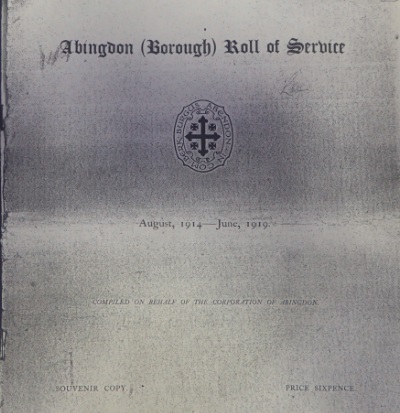
In the Abingdon (Borough) Roll of Service one entry also mentions Passchendaele.
Passchendaele
Private William John Hearne, 37a Bath Street, 2nd 2nd London Regiment, Royal Fusiliers (presumed killed Passchendaele, Oct. 26, 1917).
Passchendaele
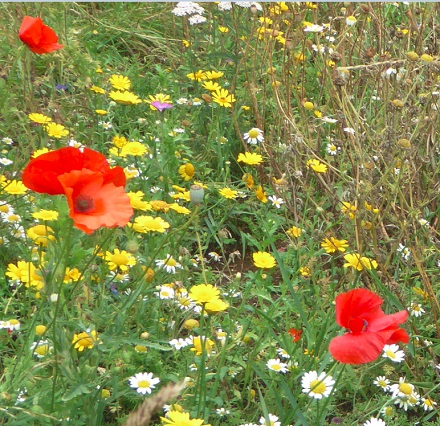
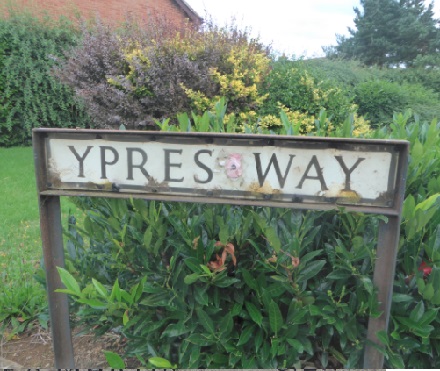
There is a faded poppy stuck to the middle of the road sign in Ypres Way in Abingdon. The first picture of wild flowers is from Barton Fields in Abingdon.